
How Homeownership Delivers Unsurpassed Family Wealth

There are many financial benefits to homeownership, but probably none more important than its ability to create family wealth.
How Housing Matters is a joint project of the Urban Land Institute and the MacArthur Foundation. It is an online resource for research and information on how homeownership contributes to individual and community success.
Their article, The First Rung on the Ladder to Economic Opportunity Is Housing, explains the importance of homeownership to a family’s financial health. In that article, they simply stated:
“The ladder to economic success can stretch only so high without the asset-building power of homeownership.”
To this point, National Association of Realtors’ (NAR) Economists’ Outlook Blog revealed in a recent post:
“Housing wealth contributes positively to the homeowner’s and children’s economic condition, because home equity can be tapped for expenditures such as investing in another property (which can generate rental income), home renovation (which further increases the home value), a child’s college education, emergency or major life events, or expenses in retirement… Housing wealth (or net worth or equity) is built up over time via the home price appreciation and the principal payments that the homeowner makes on the loan.”
Here is a graph showing the build-up of wealth over time: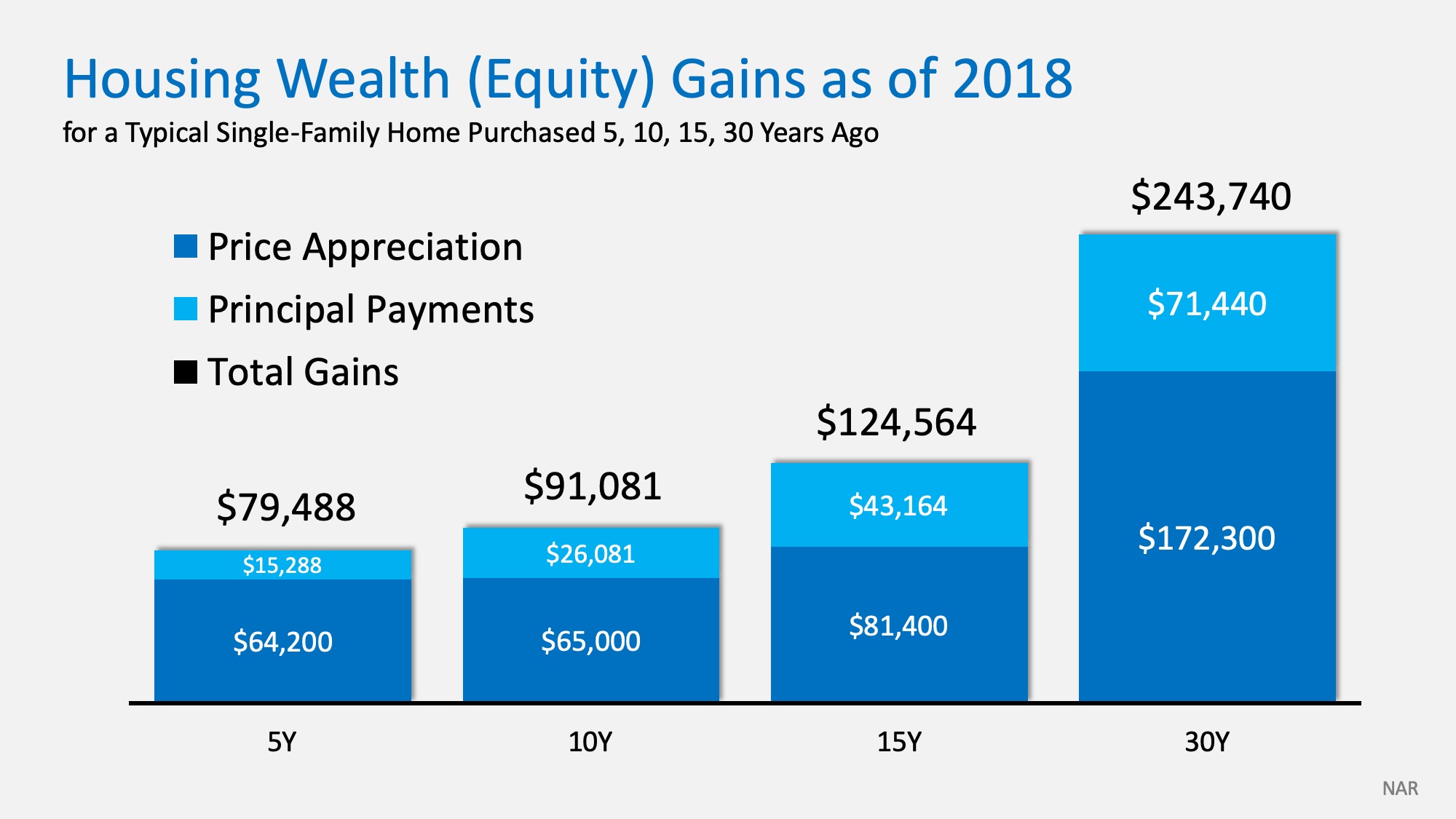 Just last month, NAR’s Chief Economist, Lawrence Yun, explained that even though home appreciation has slowed, homeowners are still building wealth:
“Homeowners in the majority of markets are continuing to enjoy price gains, albeit at a slower rate of growth. A typical homeowner accumulated $9,500 in wealth over the past year.”
Later in life, this wealth is crucial…
This wealth is important to a family’s retirement plans. In a recent report from the Joint Center for Housing Studies at Harvard University titled, Housing America’s Older Adults 2018, they revealed that a renter 65 years old or older has a net worth of $6,710. Meanwhile, a homeowner 65+ years old has a net worth of $319,200. That huge difference will allow for a dramatic upgrade in one’s lifestyle during your retirement years.
Bottom Line
Homeownership builds wealth. This, in turn, allows families to have more and better options when it comes to their children and their life in retirement.
To view original article, visit Keeping Current Matters.

Why Most People Are Still Glad They Bought a Home
A home isn’t typically something you buy for just a year or two. It’s a longer-term play. And when you zoom out, it all starts to fall into perspective – especially if you look at home prices and equity.

What Higher Mortgage Rates Mean for Home Sellers
You don’t automatically need to slash your price or offer a big concession. But you do need to price and market your house based on what buyers can pay today – not what sellers could get a few years ago.

The Mortgage Rate You See Online Isn’t Necessarily the One You’d Get
A simple conversation with a loan officer can help you determine when you’ll be ready to buy, how much you can borrow, and of course, what your real rate will be.

3 Things You Can Actually Control About Your Mortgage Rate Right Now
While you can’t control where rates go from here, you absolutely can control several things that shape the rate you actually get.

Selling This Fall? You Want To Get These 4 Things Right.
Selling your house this fall is absolutely doable. Buyer activity typically starts to slow while the number of homes for sale climb – and you need the right strategy to get attention in this type of market.

Selling This Fall? You Haven’t Missed Your Window
Getting your house sold this season comes down to how well it’s priced and presented, and that’s where a local agent shines.